



WELCOME TO AN ENTERTAINMENT SITE FOR SCOTTISH COUNTRY DANCERS!
Enjoy this curated selection of theme-related dances for celebrations and holidays, or find a dance associated with a special calendar day, or EVEN your own birthday!

Twelfth-night, David Teniers the Younger, 1634
Jan 5

Twelfth Night
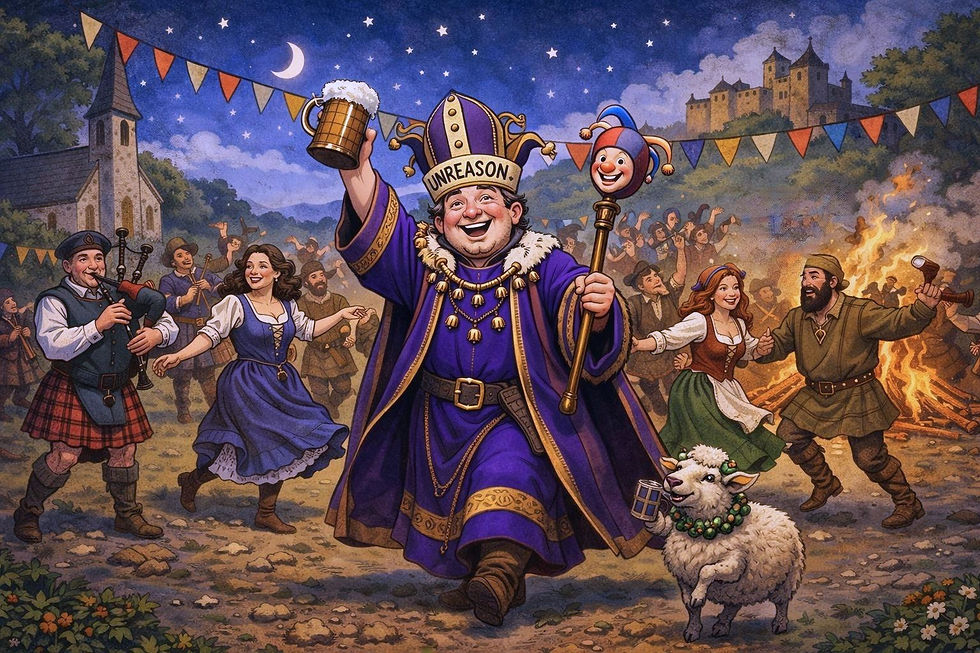
The Abbot of Unreason
Other Scottish Country Dances for this Day




Today's Musings, History & Folklore
"Come, strike up, tabor and harp, strike up, fiddle and rebeck — we grow older every moment we stand idle, and life is too short to be spent in playing mumchance.”
~ The Abbot, Sir Walter Scott, 1820
Hear, hear, Sir Walter—we quite agree. Life is far too short to be squandered on idle chance, silence, or doing nothing of consequence. Dance while you have the chance!
Which brings us neatly to that one night of sanctioned Christmas madness: traditional Twelfth Night, celebrated on either January 5 or 6, depending on your historical persuasion. Why not mark it with a dance full of merriment, mischief, and just enough trickery to keep everyone alert? No worries—the days of the Scottish Reformation are well behind us, and we may once again dance, revel, and (within reason) misbehave.
This particular jig may look straightforward at first glance, but it quickly proves otherwise. A double triangle leads into a turn that lands you right back where you started, followed by two final eight-bar phrases that split a pas de basque neatly in half—only to launch straight into a circle. Quirky, slightly unruly, and delightfully non-standard, these steps are perfectly suited to holiday revelry.
Twelfth Night was once the crowning jewel of year-end celebrations throughout the British Isles and France, with roots reaching back to the fifth century. The festivities gathered momentum with the Feast of Fools, introduced by French and English churches—a boisterous affair featuring temporary “Bishops” and “Archbishops of Fools” presiding over gleeful mischief. By the fifteenth century, things had grown a bit too exuberant for official approval, and the French government banished the antics from church settings. The spirit of revelry, however, simply spilled into the streets.
Each season crowned its own ruler of chaos: the Prince des Sots in France, the Lord of Misrule in England, and in Scotland a fine assortment of local equivalents, including the Abbot of Unreason (most areas), the Abbot of Bon Accord in Aberdeen, the Abbot of Narent in Edinburgh, and the Abbot of Unrest in Inverness.
These figures assumed their “thrones” at Halloween, ushering in three months of merrymaking that built through Christmastide, peaked gloriously on Twelfth Night, and often carried on until May Day. So dancers—pace yourselves, but don’t dawdle! 😜 💜 💗 💜 👑 🕺 💃
The Abbot of Unreason
The tradition of the Abbots of Unreason and their revelries in Scotland lasted from the late medieval period into the mid-16th century. The exact origins are difficult to pinpoint, as similar traditions of "misrule" and festive mock authority were widespread in medieval Europe. In Scotland, records of the Abbots of Unreason are particularly prominent in the 15th and early 16th centuries.
Timeline and Decline:
Medieval Origins (Pre-15th Century)The roots of the Abbots of Unreason likely lie in older, pagan-inspired seasonal festivities, combined with medieval church customs that allowed for moments of comic subversion during feast days.
Similar traditions, such as the Boy Bishops and Feast of Fools, were common in medieval Europe, suggesting a shared cultural backdrop.
Height of Popularity (15th–Early 16th Century)
The tradition flourished in Scotland during this time, particularly in urban centers and during major holidays like Christmas, Shrovetide, and May Day.
The Abbots of Unreason organized large public festivities that blended satire, revelry, and carnivalesque humor. These events were often tolerated or even encouraged by local communities.
Challenges and Suppression (Mid-16th Century)
The Scottish Reformation (beginning around 1550) marked a turning point. Led by figures like John Knox, the Protestant reformers condemned such revelry as immoral, frivolous, and incompatible with stricter religious values.
In 1555, the Scottish Parliament officially banned the Abbots of Unreason, along with other traditional festivities perceived as irreverent or disruptive. This was part of a broader effort to curb popular festivals with pagan or satirical overtones.
Lingering Traditions (Late 16th Century)
Despite the ban, remnants of the tradition persisted informally, particularly in rural areas, where old customs were slower to fade. However, by the end of the 16th century, the formal role of the Abbots of Unreason had largely disappeared in Scotland.
The suppression of the Abbots of Unreason was part of a larger trend across Europe during the Reformation and Counter-Reformation, where Protestant and Catholic authorities sought to regulate popular festivities and impose stricter moral codes.
In Scotland, the rise of Calvinist values and the increasing influence of the Kirk (Church of Scotland) played a central role in ending such traditions.
While the Abbots of Unreason formally disappeared, echoes of their spirit survived in folk traditions, seasonal festivals, and theatrical performances, highlighting the resilience of communal revelry even in the face of religious reform.
For more on the revelry during this period, click the drawing of Traditional Christmas merry-making in the banqueting hall at Haddon Hall, Derbyshire from: Joseph Nash, The Mansions of England in the Olden Time, Series I, (London, 1839).
And for the dance, see below for the Berlin Hopalots, 2016.

Click the dance cribs or description below to link to a printable version of the dance!
