


WELCOME TO AN ENTERTAINMENT SITE FOR SCOTTISH COUNTRY DANCERS!
Enjoy this curated selection of theme-related dances for celebrations and holidays, or find a dance associated with a special calendar day, or EVEN your own birthday!

A lone zebra in a herd of wildebeest - can you spot it?
Jan 31

Zebra Day
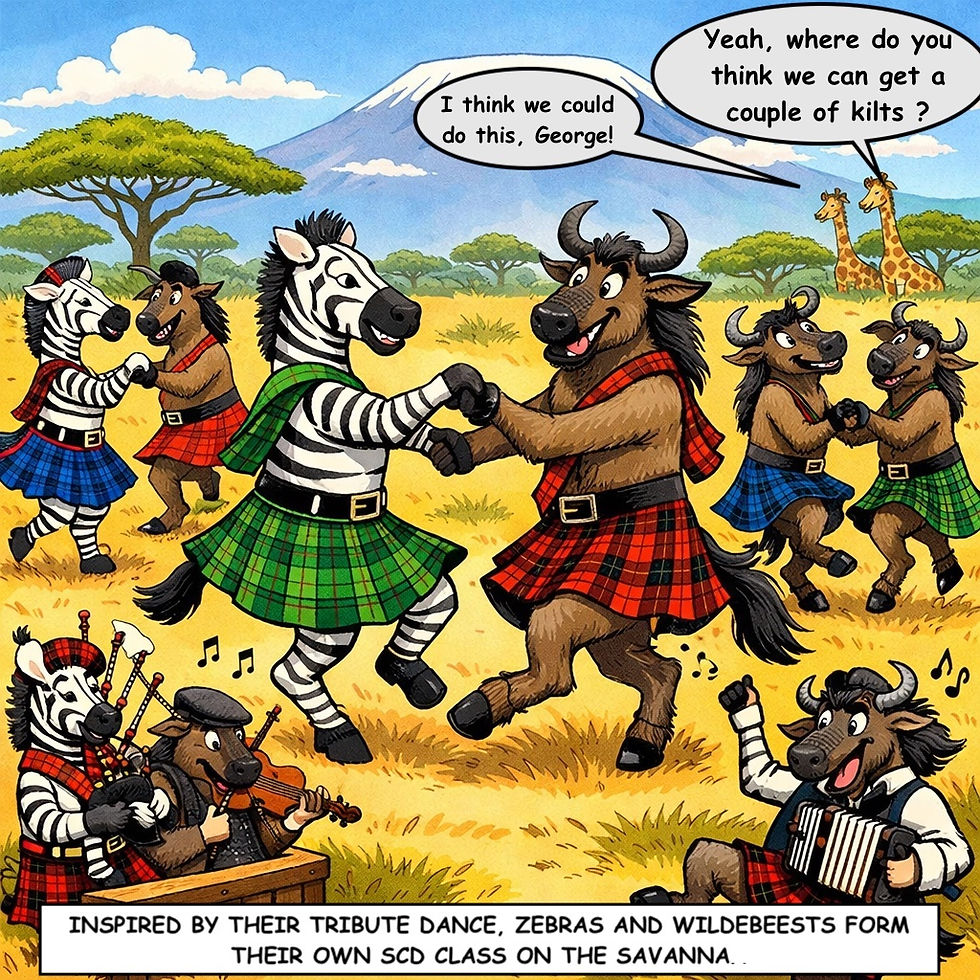
Zebras and Wildebeests
Other Scottish Country Dances for this Day
Today's Musings, History & Folklore
"A zebra and wildebeest joined ceilidh class,
One neat as a pin, one all legs and mass.
They missed every turn and drifted off course,
'More practice,' said teacher,' and point those hooves, of course!'"
What's gnu, wildebeest? Scottish Country Dance is for everyone, even if you have two left feet or two left hooves. This namesake strathspey with reels, chains, and rights and lefts—was devised as an homage to the devisor’s unforgettable time in Tanzania, and awe inspired by the sight of two flashily clad inhabitants, the zebra and the wildebeest!
While zebras sport their signature stripes, wildebeests appear as a quirky mix of cow, horse, and an overgrown beard!
Often found grazing side by side, these unlikely allies make an exceptional savanna surveillance team: the zebra’s sharp eyesight and the wildebeest’s keen sense of smell work together to detect lurking predators.
Some species embark on epic migrations, following the rains in vast, thundering herds—fittingly called implausibilities or confusions, concepts which can occur in any dance class as well!
Follow the herd, dancers! 🖤 🤍 ❤️ 🤎 🦓 🦓 🦓 🐃 🐃 🐃 🇹🇿
Zebras and Wildebeests
Happy Zebra (and other striped herding beasts such as the Wildebeest) Day!
The above famous photo of wildlife photographer Ingo Gerlach, who captured a sneaky zebra amongst a herd of wildebeest, didn’t even realize it until long after taking this shot!
There are three species of zebra: Grevy’s zebra (Equus grevyi), mountain zebra (E. zebra) and plains zebra (E. quagga), the latter of which is by far the most common. Another species of plains zebra called the quagga, was hunted to extinction in the late 19th century.
Zebras make a range of noises, some of which are the same as horses while others are unique.
Like horses, zebras will snort when excited and nicker (creating a ‘whuffle’ kind of sound by blowing air through their nose and lips) when greeting each other. But zebras also bray in a similar way to donkeys and mules. A zebra bray is wider ranging than a donkey’s, starting as a low growl and rising to a high squeal not unlike a pig. Braying like this can be heard over great distances and is used to find potential mates.
Besides providing camouflage, the zebra’s famous stripey coat is thought to disperse more than 70 per cent of incoming heat, preventing the animal from overheating in the African sun. Air moves at different speeds over light-absorbing black stripes and light-reflecting white stripes, creating own cooling air currents. This monochrome pattern also seems to throw off the visual systems of biting flies.
A dazzle of zebras is the most common collective noun, named for the motion dazzle effect created by a group of running zebras. Other terms include the common "herd" and "zeal" of zebras.
Often found together with zebras, wildebeest, also known as gnus, are a type of antelope.
Zebras and wildebeest group together in open savannah environments with high chances of predation. This grouping strategy reduces predation risk because larger groups decrease each individual's chance of being hunted. Fascinatingly, the seasonal presence of thousands of migratory wildebeests reduces local lion predation on giraffe calves, resulting in greater survival of giraffes!
To see and learn more about the mass migration of wildebeest across the the Serengeti to find fresh grazing ground, fording crocodile-infested rivers and evading predators such as lions, cheetahs, and hyenas, click the combination of wildebeest and zebras below.

Click the dance cribs or description below to link to a printable version of the dance!
