


WELCOME TO AN ENTERTAINMENT SITE FOR SCOTTISH COUNTRY DANCERS!
Enjoy this curated selection of theme-related dances for celebrations and holidays, or find a dance associated with a special calendar day, or EVEN your own birthday!
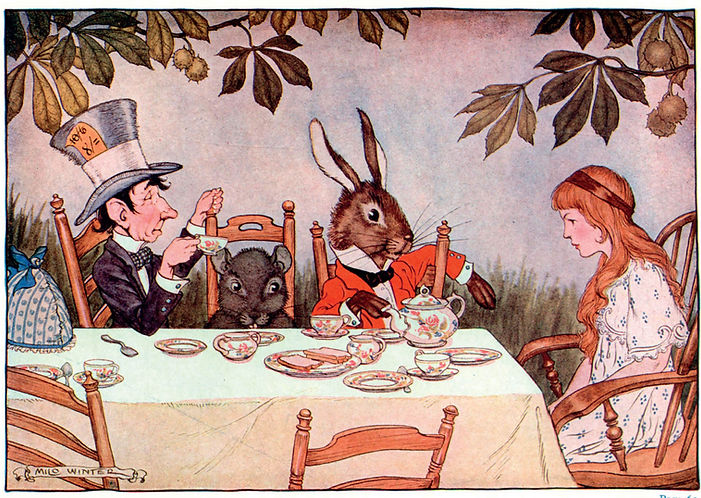
The Mad Tea Party by Milo Winter (1888-1956)
Oct 6

Mad Hatter Day
The Mad Hatter
Other Scottish Country Dances for this Day


Today's Musings, History & Folklore
"But I don’t want to go among mad people," Alice remarked.
"Oh, you can’t help that," said the Cat: "we’re all mad here. I’m mad. You’re mad."
~ Alice's Adventures in Wonderland, Lewis Carroll, 1865
Channel your inner—or outer—crazy today for Mad Hatter Day, traditionally celebrated on 10/6, a nod to the wonderfully quirky label tucked into the Hatter’s famous hat in Lewis Carroll’s Alice’s Adventures in Wonderland. Sir John Tenniel’s illustration shows the label “In this style 10/6”—the price of the hat, ten shillings and sixpence. Curiously, Carroll never actually calls him the “Mad Hatter”; he is simply the Hatter, although the Cheshire Cat assures Alice that both the Hatter and the March Hare are mad.
And “mad as a hatter” was already an old expression by the time Alice tumbled down the rabbit hole in 1865. It appears in print as early as the 1820s and is often associated with a very real occupational hazard of hat-making. During the 18th and 19th centuries, mercury compounds were used in processing fur for felt hats, and prolonged exposure could cause mercury poisoning, with tremors—the infamous “hatter’s shakes”—along with irritability, mood and memory changes, speech difficulties and other neurological symptoms. Although historians aren’t certain that mercury poisoning actually originated the expression, the illness among hatters was very real.
Fortunately, the madness in today’s Mad Hatter is considerably more cheerful! This lively, easy-to-learn 32 bar jig for 3 couples in a 4 couple tea party devised by Iain Boyd includes advances and a Do Si Do with corners—just the thing for a set full of mad tea-party enthusiasts. Perhaps all that changing of places at the Hatter’s tea table was really just Scottish country dancing waiting to happen: “Clean cup! Move down!”
So wear the most outlandish hat available, don’t stint on the tartan and paisley, and save a place at the table for a post-dance cup of tea. After all, as the Cheshire Cat famously tells Alice, “We’re all mad here.” ❤️ 💚 💜 💙 💛 🎩 🐇 ♠️ ♥️ ♦️ ♣️ 🎉 ☕
The Mad Hatter
Mad Hatter Day, October 6th, gets its designated date from the price tag "10/6" (translating to October 6th in the month/day format) on the illustrations of the Hatter's hat from Lewis Carroll's fantasy story, Alice's Adventures in Wonderland.
The Hatter wears a large top hat with a hatband reading "In this style 10/6". This is the hat's price tag, indicative of his trade, in pre-decimal British money as ten shillings and six pence (or half a guinea).
The Hatter character, alongside all the other fictional beings, first appears in Lewis Carroll's 1865 novel Alice's Adventures in Wonderland. In the story, the Hatter explains to Alice that he and the March Hare are continually stuck at tea time because when he tried to sing for the Queen of Hearts, the foul-tempered monarch sentenced him to death for "murdering the time." Although he escapes decapitation, "time" in a show of solidarity (and referred to as a "he" in the novel) halts himself out of respect to the Hatter, keeping him and the March Hare stuck at 6:00 pm, tea time, forever.
It has often been claimed that the Hatter's character may have been inspired by Theophilus Carter, an eccentric furniture dealer and a one time a servitor at Christ Church College, at Oxford. He was nicknamed the "Mad Hatter" from his habit of standing in the door of his shop wearing a top hat.
The expression, "mad as a hatter," a term which predates Carroll's stories, lives on in the terms "Mad hatter disease," or "mad hatter syndrome," which describe occupational chronic mercury poisoning common amongst hat makers whose felting work involved prolonged exposure to mercury vapors. The characteristic neurotoxic effects included tremor, pathological shyness, and irritability.
For a recipe worthy of a mad person, try a "Mad Hatter" cocktail with equal parts potion of vodka, peach schnapps, lemonade, and coca-cola.
Or try an Alice-approved 'Drink Me' potion with almost all the named ingredients from the story by clicking the picture of the Hatter at his perpetual tea by John Tenniel:
"…so Alice ventured to taste it, and, finding it very nice (it had, in fact, a sort of mixed flavor of cherry-tart, custard, pine-apple, roast turkey, toffy, and hot buttered toast), she very soon finished it off.”
~Alice in Wonderland, Lewis Carroll

Click the dance cribs or description below to link to a printable version of the dance!
