

WELCOME TO AN ENTERTAINMENT SITE FOR SCOTTISH COUNTRY DANCERS!
Enjoy this curated selection of theme-related dances for celebrations and holidays, or find a dance associated with a special calendar day, or EVEN your own birthday!

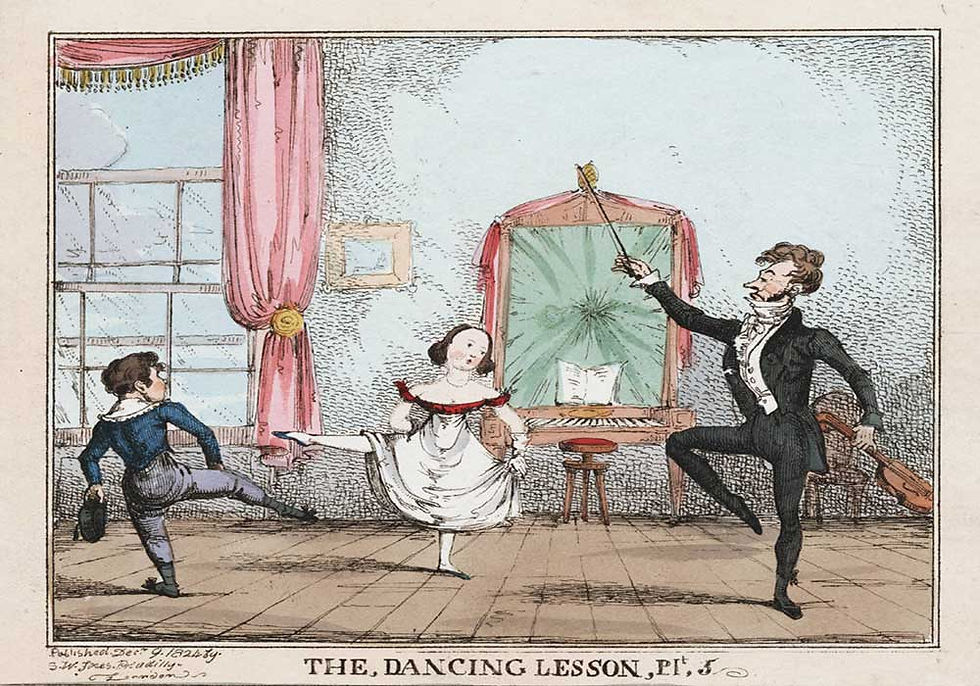
The Dancing Lesson," by George Cruikshank (1835)
Apr 29

International Dance Day
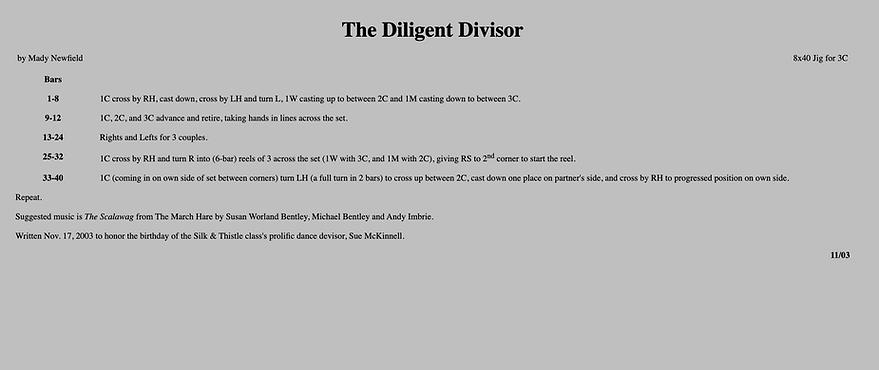
The Diligent Devisor
Other Scottish Country Dances for this Day

Today's Musings, History & Folklore
“Let us read, and let us dance; these two amusements will never do any harm to the world.”
~ Voltaire (1694-1778)
In these days, when even independent thought can be considered a danger to the world, let us hope to continue dancing un-impugned and uninterrupted.
Thank you devisors, past, present, and future, who keep the catalogue of dances a living library for Scottish Country Dancers.
Written for the birthday of one of Chicago's Silk & Thistle's prolific devisors, Sue McKinnell, this 40 bar jig for three couples devised by Mady Newfeld, contains all the classic elements of a favorite dance.
International Dance Day is held on the anniversary of the birth of Jean-Georges Noverre (1727–1810), creator of modern ballet, and celebrates dance in all its forms and importantly, honors all the dancing teachers and choreographers and devisors who dedicate their lives to passing on traditions and techniques and creating new artistic expression in the form of movement. And let’s not forget the musicians and composers whose melodies bring those dancing feet to life. Thank you, all! 🕺 💃 💗 💗 💗 🏴 🩰 🎶
The Diligent Devisor
April 29th is International Dance Day, a day to celebrate all forms, styles, and genres of dancing and to remember the dance teachers in our lives!
International Dance Day was introduced in 1982 by the International Dance Council (CID, Conseil International de la Danse). Although the date is not linked to a particular person or a particular form of dance, it is the day when the French dancer and ballet master Jean-Georges Noverre was born, generally considered the creator of ballet d'action, a precursor of the narrative ballets of the 19th century.
Francis Peacock (1723 – 26 June 1807) was a Scottish dance teacher and musician. He is considered the "Father of Scottish country dancing."
Peacock was possibly born in York. He studied dancing under the celebrated George Desnoyer, who was later the dancing master at the court of King George III.
In 1742, citizens of Aberdeen appealed to the town council "that the town was at great loss for want of a right dancing master to educate their children." A few years later the town hired James Stuart of Montrose, Angus as the dancing master (an early term for dance teacher) but he was apparently found lacking; in 1746 the council advertised again for "a person of sober, discreet and moral character."
John Dawney, dancing master of Edinburgh, recommended Francis Peacock, also living in Edinburgh. On 14 February 1747, the town council appointed the 23-year-old Peacock as official and only dancing master of Aberdeen. He was paid seven shillings sterling per student per month, together with some money to organise the music.
In Aberdeen, Peacock established the first school of dance as well as the Aberdeen Musical Society. The society was founded with the physician John Gregory, organist Andrew Tait, and music copyist David Young. For almost 60 years, Peacock acted as a director and occasional violinist for the society, with profits from private concerts going to charity.
Peacock's teaching career in Aberdeen lasted five decades. Many of his students included the Scottish nobility; Peacock firmly believed that dancing was a vital activity for young people to learn grace and manners. He writes,
"I may here observe, that there cannot be a greater proof of the utility of Dancing, than its being so universally adopted, as a material circumstance in the education of the youth of both sexes, in every civilised country. Its tendency to form their manners, and to render them agreeable, as well in public as in private; the graceful and elegant ease which it gives to the generality of those who practice it with attention, are apparent to everyone of true discernment."
In the 18th century the most fashionable dancing masters were visible members of society. Not only did they teach the great and the good, but they held and officiated at public balls and they advertised their services assiduously in the newspapers and elsewhere. The Lowe Brothers, a family of highly successful Scottish dancing masters who specialised in teaching Assembly Room dancing in 1820s Scotland, were also the co-authors of a particularly useful book on dancing called Lowes' Ball-Conductor and Assembly Guide. The four brothers, Robert (1791-1853), John (1793-1839), Joseph (1796-1866) and James (1798-18??), ran academies across the Scottish lowlands. Joseph achieved particular fame as a dancing master to the children of Queen Victoria in the 1850s.
And for more on Scottish Dancing Masters in history, click the George Cruikshank illustration of "The Dancing Lesson", 1835.

Click the dance cribs or description below to link to a printable version of the dance!