

WELCOME TO AN ENTERTAINMENT SITE FOR SCOTTISH COUNTRY DANCERS!
Enjoy this curated selection of theme-related dances for celebrations and holidays, or find a dance associated with a special calendar day, or EVEN your own birthday!

Feb 24

Birthday of Thomas Newcomen
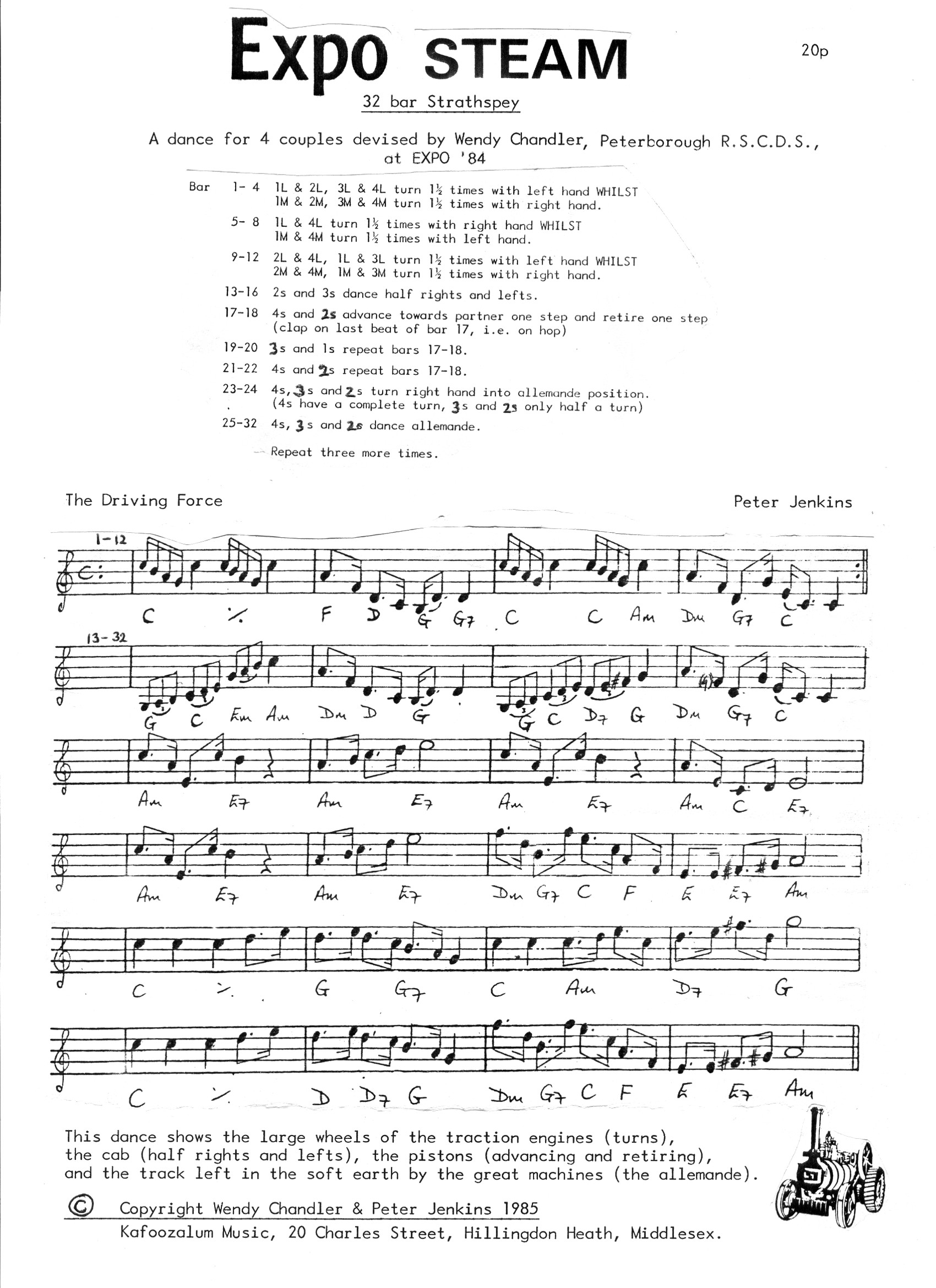
Expo Steam
Other Scottish Country Dances for this Day


Today's Musings, History & Folklore
"🎵 I got *sss* steam heat
I got *sss* steam heat
I got *sss* steam heat
But I need your love to keep away the cold!"
~ Steam Heat, The Pajama Game, 1954
Yes indeed, we enjoy the benefits of steam heat, electricity, and even pajamas because of human achievement and inventors who spent their time inventing and probably could have used a dancing night out!
But in the large canon of Scottish Country Dance, we remember and celebrate history’s achievements and the innovations that shape our world! This strathspey, devised at the 1984 Exposition, one of many annual shows throughout the world which highland and demonstrate vintage engines of all sorts, mimics:
* the large wheels of the traction engine (turns)
* the cab (rights and lefts)
* the pistons (advancing and retiring)
* the track left in the soft earth by the great machines (the allemande)
And it even comes with its own tune, "Drivin' Force"!
Thomas Newcomen, was one such inventor who revolutionized industry in the early 18th century. Born in 1664 in Devon, England, Newcomen was a blacksmith and ironmonger whose groundbreaking creation—the atmospheric steam engine—laid the foundation for the Industrial Revolution.
First built in 1712, his engine provided a practical and efficient solution to a major problem: pumping water out of mines. Unlike earlier steam-powered attempts, Newcomen’s design harnessed atmospheric pressure, condensing steam to create a vacuum that drove a piston within a cylinder. This simple yet ingenious mechanism powered industry for decades, marking a transformative leap in technology. 💛 ❤️ 💛 💨 💨 💨 🚂 🚂 🚂
Expo Steam
Thomas Newcomen’s name graces the Newcomen Society because he was the inventor of the first practical working steam engine around 1712, a machine that initiated the age of industrial steam power. The Newcomen Society itself is dedicated to studying the history of engineering and technology — both in honor of Newcomen’s pioneering work and across many later developments in industrial history — through publications, lectures, archival research and other scholarly activities.
Newcomen’s engine — often called the Newcomen atmospheric engine — represented a major breakthrough in applying steam power to solve real industrial problems. Before his design, miners struggled with flooding in deep coal and tin workings, which could only be cleared inefficiently with human or animal power. Newcomen’s engine used steam to create a vacuum inside a cylinder, allowing atmospheric pressure to push a piston and drive a mechanical pump. This design was the first practical device to harness steam to produce continuous mechanical work, and hundreds of these engines were constructed throughout Britain and Europe in the 18th century.
The impact of Newcomen’s work extended far beyond individual mines. By enabling reliable pumping and mechanical power that did not depend on waterwheels or muscle power, his atmospheric engine helped open deeper mineral extraction and provided a new energy source that would become central to the Industrial Revolution. Later innovators like James Watt built on Newcomen’s fundamental principles to create more fuel-efficient engines suitable for factories and transport, but it was Newcomen’s original breakthrough that laid the groundwork for all subsequent steam-powered machinery.
In short, Newcomen’s contributions were both technical — inventing a working steam engine — and historical, providing a foundation for industrial engineering and mechanical power that transformed economies and societies. The modern Newcomen Society carries forward his legacy by promoting the study of engineering history from ancient times to the present.
For more, click the Newcomen engine!

Click the dance cribs or description below to link to a printable version of the dance!