


WELCOME TO AN ENTERTAINMENT SITE FOR SCOTTISH COUNTRY DANCERS!
Enjoy this curated selection of theme-related dances for celebrations and holidays, or find a dance associated with a special calendar day, or EVEN your own birthday!

"Freakshakes" with Candy Floss & Doughnuts
Jul 31

Cotton Candy Day
Candyfloss
Other Scottish Country Dances for this Day


Today's Musings, History & Folklore
"Cotton candy, cotton candy,
Sweet and fluffy, pink and dandy!
Spin it high, spin it low,
Round and round the fair we go!
Pink, blue, yellow, white,
Sticky hands are out of sight!"
~ Cotton Candy Jump Rope Rhyme
How sweet it is!
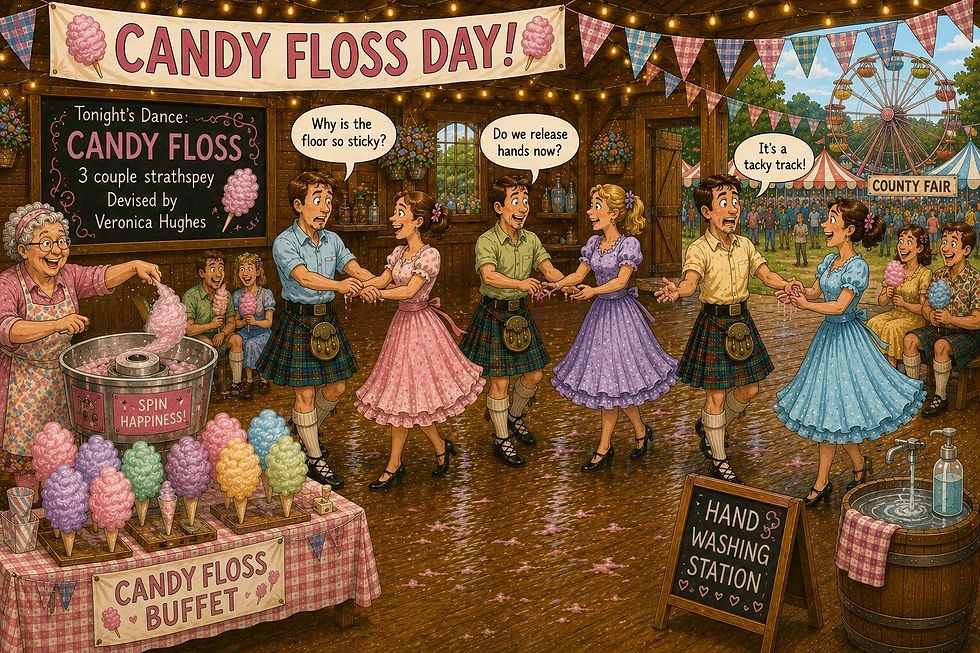
Watch those sticky fingers during the handing in this sticky 32 bar strathspey for three couples devised by Veronica Hughes! With a "meanwhile", hands across, reels and promenades, all you need is some sugar to mimic the spinning mechanism of the the Candy Floss machines, something that you can still see at summer fairs and boardwalk sweet shops on the coast!
In one of history's most amusing ironies, this confection was invented in 1897 by a dentist, William Morrison, together with confectioner John C. Wharton of Nashville, Tennessee. They created a machine that heated and liquefied sugar before spinning it into thousands of delicate sugar threads, giving birth to the airy confection they called fairy floss.
The sweet made its dazzling public debut at the 1904 World's Fair in St. Louis, where visitors eagerly purchased more than 68,000 boxes. Its magical appearance and melt-in-your-mouth texture quickly made it an enduring favourite at fairs, carnivals, circuses, and festivals around the world.
As the treat spread internationally, so did its names. In Australia it has remained fairy floss, preserving the original Victorian-era name. Across Britain, Ireland, New Zealand, South Africa, and many Commonwealth countries, it is more commonly called candy floss, a name that evokes the delicate strands of spun sugar. In France it is known as barbe à papa ("Daddy's beard"), while Italians enjoy zucchero filato ("spun sugar"). Germans call it Zuckerwatte ("sugar cotton"), and in Spain it is algodón de azúcar ("sugar cotton"), both names inspired by its cloud-like appearance.
Are you a fan of this old-fashioned confection? Do you prefer blue or pink! 🕺 💃 ❤️ 💙 💛 💗 🎪 🎪 🎪 🎈 🎈 🎈 🍭 🍭 🍭 😊
Candyfloss
One of the magical things about candy floss is that it isn't made with any special ingredients at all—it is almost entirely ordinary granulated sugar. The magic lies in the machine. Sugar is heated until it melts, then forced through dozens of tiny holes by centrifugal force. As the fine threads hit the cooler air, they instantly harden into delicate strands of edible "sugar glass." Those thousands of microscopic strands trap pockets of air, giving candy floss its famously light, fluffy texture.
Although it feels feather-light, candy floss is surprisingly economical. A single serving often contains less sugar than many chocolate bars or large soft drinks because so much of it is simply air. The enormous cloud is mostly an illusion of volume, created by miles of incredibly fine sugar threads wrapped around a paper cone or stick.
Long before modern fairgrounds, European confectioners delighted royalty by creating elaborate spun-sugar sculptures by hand. These intricate sugar decorations were expensive and time-consuming because they required skilled artisans to pull and spin molten sugar. The invention of the spinning machine transformed what had once been an extravagant luxury into an affordable treat that anyone could enjoy at a carnival or county fair.
The world's largest cotton candy was created in Italy in 2015 and measured more than 2,800 metres (over 9,000 feet) in length if its sugar strands were stretched out. While impossible to eat in one sitting, it demonstrated just how remarkably fine—and surprisingly strong—those spun sugar threads can be.
Today, candy floss has become far more colourful than its original white form. Modern machines can produce vibrant pink, blue, purple, yellow, and even rainbow swirls, while adventurous confectioners create flavours ranging from classic vanilla and strawberry to bubble gum, watermelon, maple, and even unusual gourmet varieties such as lavender, champagne, or pickle!
For a recipe for a Candy Floss cupcakes which might be better for less sticky hands for dancing, click the cupcakes!

Click the dance cribs or description below to link to a printable version of the dance!
