



WELCOME TO AN ENTERTAINMENT SITE FOR SCOTTISH COUNTRY DANCERS!
Enjoy this curated selection of theme-related dances for celebrations and holidays, or find a dance associated with a special calendar day, or EVEN your own birthday!
Feb 14

Valentine's Day
St Valentine's Chase
Other Scottish Country Dances for this Day


Today's Musings, History & Folklore
"I dinna care how poor ye be,
If ye be mine, that’s wealth to me."
Chase your Valentine partners and corners in this 32 bar strathspey!
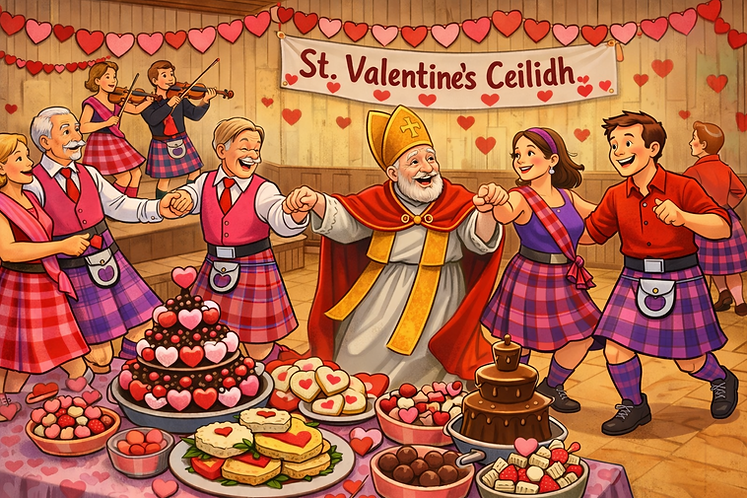
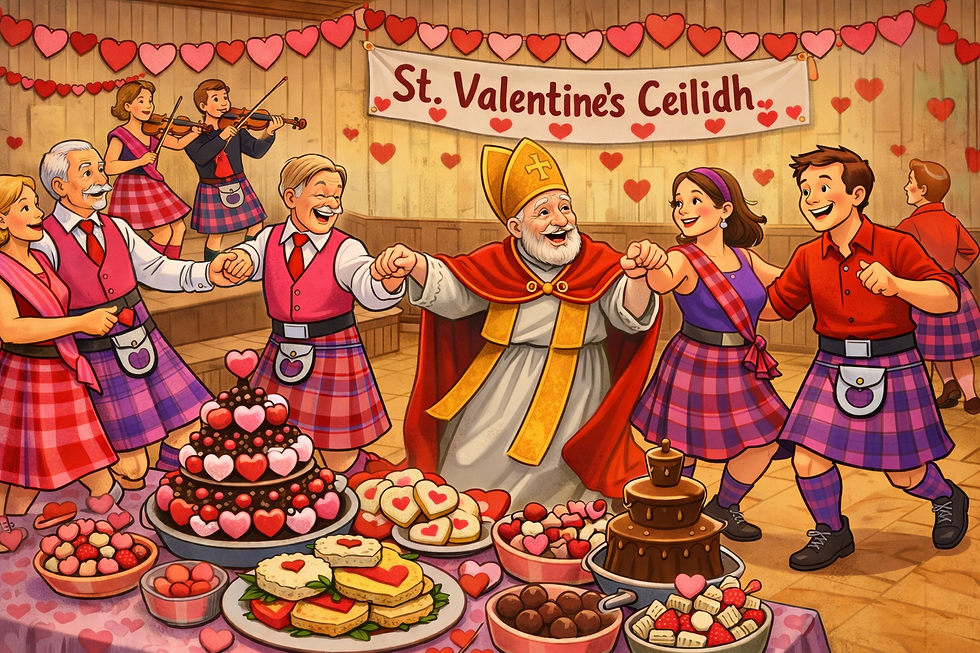
Many Scottish Country Dance groups hold a special Valentine's party or ball during February! How sweet! This Valentine's Dance is a perfect 32 bar strathspey with lots of chasing and reeling for such an evening!
St. Valentine’s Day, celebrated each year on February 14, traces its origins to the early Christian centuries of the Roman Empire. The historical Valentine was likely one of several Christian men named Valentinus living in the third century. Later tradition describes him as a priest—possibly even a bishop—who became associated with defending Christian marriage at a time when such practices were not always welcomed by imperial authorities. Over time, his story became intertwined with themes of fidelity, devotion, and steadfast love.
Medieval legend added a tender layer to his reputation. One well-known tale tells that while imprisoned, Valentine befriended—or even healed—the jailer’s blind daughter, and before his death sent her a note signed “from your Valentine.”
The mid-February date may also reflect the ancient Roman festival of Lupercalia, a seasonal celebration connected with fertility and the coming of spring. By the Middle Ages, February 14 had become linked with courtly love, particularly in England and France, where it was popularly believed that birds began choosing their mates at this time of year!
Valentine’s Day began gaining broader popularity in the 17th and 18th centuries, but it flourished in the Victorian era of the 19th century, when inexpensive postage and mass-produced lace-paper cards made exchanging valentines fashionable across Britain and America. What had once been a saint’s feast day evolved into a widely celebrated occasion marked by handwritten notes, flowers, sweets, and symbolic tokens of love. ❤️ 💜 💗 ❤️ 💌 💌 💌
St Valentine's Chase
Valentine’s Day, observed on February 14 in many parts of the world, has developed distinct customs shaped by local culture, history, and social norms. While often associated with romantic love, its expressions vary widely from country to country.
In the United Kingdom, Valentine’s Day has roots in medieval courtly tradition. By the 18th century, it was customary to exchange handwritten notes and small tokens. Victorian “vinegar valentines” added a humorous or even satirical twist, sending caricatured cards that gently mocked their recipients. Today, the holiday typically involves cards, flowers, chocolates, and restaurant outings, though the British tone often blends romance with understated wit.
In France, often called the “land of romance,” Valentine’s Day focuses primarily on couples rather than friends or children. Historically, France was home to an unusual custom called une loterie d’amour (a love lottery), in which single people paired off by calling to one another from facing houses; dissatisfied participants could reject their matches, sometimes leading to bonfires where tokens were burned. Although that practice was banned centuries ago, France remains associated with romantic gestures such as handwritten letters and elegant dinners.
In Italy, Valentine’s Day (San Valentino) emphasizes romance, but older traditions once included young unmarried women rising before dawn to spot their future husbands in passing men. Today, couples exchange gifts, and the “Baci Perugina” chocolate — wrapped with printed love notes — has become a symbolic treat. The day is also associated with small love locks attached to bridges in some cities, symbolizing enduring affection.
In Japan, Valentine’s Day developed a distinctive commercial structure in the 20th century. Women traditionally give chocolates to men, with different categories signaling varying levels of feeling: giri-choco (obligation chocolate) for colleagues or acquaintances, and honmei-choco for romantic interest. A month later, on March 14 (“White Day”), men reciprocate with gifts. This reciprocal custom has spread to South Korea and Taiwan, each adapting it slightly.
In Scotland, while the day is celebrated similarly to other parts of the UK, there has historically been a playful “name-drawing” custom at social gatherings, where participants drew a name at random and treated that person as their Valentine for the day — sometimes exchanging small gifts or dances. This echoed earlier European pairing traditions and often took place at community events rather than strictly private romantic settings.
In the United States, Valentine’s Day expanded in the 19th century with the rise of mass-produced greeting cards, notably popularized by Esther Howland in the 1840s. The holiday broadened beyond couples to include children exchanging classroom cards and friends celebrating affection more generally. Candy hearts, roses, and themed merchandise have become iconic symbols.
For more on the real St. Valentine who inspired this day of love, click the Bishop of Myra!

Click the dance cribs or description below to link to a printable version of the dance!
